
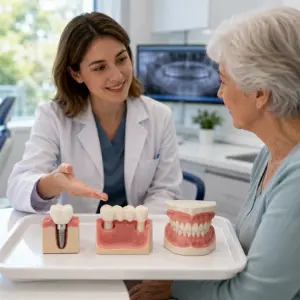
Losing a tooth can affect more than just your smile. When a gap is left untreated, the surrounding teeth may gradually begin to shift out of place. This movement can change the way your teeth fit together, affect how you chew, and create new areas where plaque and food can collect. That is why replacing a missing tooth is often important not only for appearance, but also for protecting long-term oral health.
If you are researching dental implants in Sacramento, you will quickly run into two other common alternatives: dentures and bridges. Each can be the right choice in the right situation, but they solve the problem in different ways.
The best choice usually comes down to (1) how many teeth are missing, (2) the health of your gums and jawbone, (3) how you want the replacement to feel day-to-day, and (4) how much maintenance you are comfortable with.
In our experience, the biggest regrets happen when patients choose based on a single factor (like speed) without fully considering bite forces, bone support, and cleaning needs over the next several years.
A dental implant is a small post placed in the jawbone that acts like a replacement root. A crown (the visible tooth) is attached after healing. Many patients choose implants because they want a fixed solution that does not rely on neighboring teeth for support.
For an overview of how implants work, see our page on dental implants in Sacramento.
A traditional bridge replaces a missing tooth by anchoring a replacement tooth (pontic) to crowns on the two adjacent teeth. It is fixed in place, but it depends on the teeth next to the gap.
If you want to learn more about restorations that support bridges, our dental crowns page explains how crowns protect and reinforce teeth.
Dentures can replace several teeth or an entire arch. Some are removable, while implant-supported dentures use implants to add stability. Dentures can be an efficient, proven way to restore function, especially when multiple teeth are missing.
You can review types and expectations on our dentures service page.
Bridges can be a good fit when the adjacent teeth already need crowns due to existing damage or large fillings. If neighboring teeth are healthy and untouched, some patients prefer an implant so the adjacent teeth do not have to be reshaped to support a bridge.
Implant planning typically considers gum health and bone support. If bone support is limited, your dentist may discuss options to improve the foundation or recommend an alternative that better fits your anatomy and timeline.
No option is truly maintenance-free. The difference is how you clean it.
Bridges and some dentures can sometimes be completed faster than implants, depending on your case. Implant treatment typically includes a healing phase before the final crown or restoration is placed. If you need a solution quickly, a dentist can often discuss temporary options while you work toward a longer-term plan.
| Category | Implants | Bridges | Dentures |
|---|---|---|---|
| Stability | Fixed; typically high stability | Fixed; relies on neighboring teeth | Removable; stability varies, can be improved with implants |
| Effect on adjacent teeth | Does not require reshaping adjacent teeth | Usually requires crowns on adjacent teeth | May use clasps or rest on gums |
| Cleaning | Brush and clean around implant daily | Needs under-bridge cleaning routine | Remove and clean daily (removable types) |
| Common best fit | Single tooth gaps, multiple tooth replacement plans | Single tooth gap when adjacent teeth need crowns | Multiple missing teeth, full-arch replacement options |
Whether you start by asking a general dentist in Sacramento about dentures, bridges, or implants, your consultation should connect the recommendation to your specific mouth, not just general pros and cons. A thorough evaluation often includes:
If you are still deciding who to see first, our general dentistry page explains what a comprehensive visit can cover.
Candidacy depends on overall health, gum health, and whether there is enough healthy bone to support an implant. A dental exam typically evaluates your bite, gum condition, and imaging to confirm available bone and plan the safest approach.
A traditional fixed bridge can be a good option in some cases, especially if the neighboring teeth already need crowns. Your dentist will weigh the condition of the adjacent teeth, your bite forces, and cleaning ability before recommending a bridge.
Many patients find implants feel closest to natural teeth because they are fixed and function independently. Fixed bridges can also feel natural, while removable dentures may take more adjustment and can move slightly depending on fit and anatomy.
Longevity varies based on oral hygiene, bite forces, and regular dental care. Implants are designed for long-term support, bridges can last many years with excellent care, and dentures often need adjustments, relines, or replacement over time as the mouth changes.
Ask which options fit your specific case, what prep is needed, expected maintenance, how each option affects nearby teeth, and what the timeline looks like for healing and final restoration. It is also reasonable to ask how your bite will be protected long-term.
Implants, dentures, and bridges are all established ways to replace missing teeth, but the best choice is the one that fits your mouth, your comfort goals, and your long-term maintenance habits. A careful exam is what turns internet research into a safe plan.
If you are weighing implants vs dentures vs bridges, our team can help you compare options based on your bite, gum health, and goals. To schedule a visit with Dr. Lilliana Stojic, call 916-487-5147.
Patient Testimonials
Beautiful office, friendly staff, terrific dental care.
by Trevor Derrett
Had a great visit today and got to know the people that work there. They made me feel comfortable as the change of ownership is taking place.
by Bonnie Schrader
I am so impressed with the entire experience. From the friendly reminders, to entering the office, and especially the dentist! My previous dentist Stephen C Ott, DDS, was incredible. I had the benefits of his gift since 1971. I was worried about finding a new dentist. However, I was blessed to have Dr. Ott recommend his dentist: Dr. Lillian Stojic. I recommend her to all!!!
by John Murphy III
I've been seeing dr stojic since I moved to town 18 years ago, my whole family has transitioned over there and I love the whole team! Keep up the great work!
by Carrie Carsell
Dr. Lilliana and her staff make getting teeth cleaned and a cavity filled as good an experience as possible. They get the job done with minimal pain and discomfort.
by Age Advantage S.
I just had a visit to Dr. Stojic's office. My ten year old daughter had an infected tooth that had to be extracted. She was so nervous and scared at the possibility of an extraction. When we arrived we were greeted warmly by her office manager and then by her equally kind assistant who brought us back to her room...
by Kristi L.
Dr. Lilliana and her staff are not only effective and efficient, but they also remove my anxiety. When I had to have a root canal, I was nervous about the pain. I was given the choice of Nitrous oxide gas and that calmed me.
by Gail M.
Dr. Stojic saw two of my children. The youngest was so comforted by her easygoing and confident demeanor that he was the quietest and most still 4 year old I've seen in a dentist chair! Our older son was very afraid of the dentist and has been to a couple other dentists who were unable to treat him because of his scared behavior. Dr. Stojic was very patient and helped him understand what she was doing at every step, which calmed him down so she was able to fill his cavities and even extract a tooth. We were thoroughly impressed with Dr. Stojic and her office and staff.
by Brittani B.
Schedule Your Appointment
Global Smiles Sacramento – Dr. Lilliana Stojic DDS, MAGD
Cosmetic & Family Dentistry
1801 Professional Drive | Sacramento, CA 95825
Phone: 916-487-5147 | Fax: 916-626-4944